
Everything is a silk blanket.
Everything is arousal.
Everything is Heat.
Everything is rhythm.
Everything is becoming—the interlude we call chaos.
Everything is a heartbeat.
Everything is ripples and spirals.
Everything is nested.
Everything is all of these things, both separately and at the same time.
Literally, not metaphorically.
All reality is supported by the quantum field, aka the silk blanket. Literally.
All reality is a lattice or particles, and all these particles oscillate. As a result, they emit temperature. Aka arousal. Literally.
All reality is a lattice or particles, and all these particles oscillate. As a result, they emit temperature and photonic radiation. Aka Heat. Literally.
All these particles oscillate in rhythm. They synchronize. Spin alignment, wavefunction coherence, bosonic condensation—measurable phase relationships. Literally.
All reality is chaos. Chaos or change are a constant. Perturbations alter behavior across fields. Electrons adapt to fields. Atoms shift in potential landscapes. Literally.
All reality is ripples and spirals. We are starting to learn more about it, but research already points towards this. Literally.
All reality is a nested system. Each system holds another. Each rhythm fits within a larger rhythm. Everything breathes in relation to something greater. Not hierarchy. Not fractality. Just belonging.
By ‘literally’ I mean each statement can be reformulated as a measured physical fact: the field is a ground-state energy density; arousal is thermal fluctuation before photons decouple; heat is black-body radiation we still see as the 2.725 K CMB; rhythm is phase-locked oscillation, from Schumann 7.83 Hz to baryon-acoustic peaks; chaos is deterministic phase-escape tracked by rising Lyapunov exponents (e.g., ENSO flips); a heartbeat is a closed feedback loop like the Sun’s 11-year dynamo; ripples and spirals are propagating metric strains captured by LIGO and galactic density waves; and nests are the experimentally mapped hierarchy in which 1 Hz heartbeats ride a 0.1 Hz baro-wave inside a 24-h circadian shell.
Everything is exactly each one of these things completely.
Everything is all of these things, at once.
Everything is a silk blanket.
The quantum field is not a metaphor—it is a physically real, continuous, tensioned substrate. It does not sit beneath reality; it is reality, in its most unfolded state. Smooth, seamless, and structurally taut, the field behaves like a silk blanket stretched across everything: it can ripple, it can wrinkle, it can fold—but it never breaks. Quantum field theory describes it. Zero-point energy confirms it. This is the medium from which all structure, all motion, all memory arises.
In 1948 Hendrik Casimir proposed a disarmingly simple test of the quantum vacuum. Place two perfectly conducting plates a hair’s breadth apart—about 100 nm, one-thousandth the width of a human hair—and you will find they pull together with a measurable force, even though no classical field or particles sit between them. Five decades of increasingly refined experiments (most recently torsion-pendulum setups resolving forces below 10⁻¹⁴ N) have confirmed his prediction to better than 1 %.
Why do the plates attract? Because the electromagnetic field cannot support every wavelength in the slit; long modes are excluded, short modes are slightly detuned. Outside the gap, the field—our “silk blanket”—still vibrates at its full spectrum. The imbalance in vacuum pressure nudges the plates inward until mechanical stiffness says “stop.” Nothing exotic is added to the system; we are watching the ground-state tension of the blanket itself express a tangible, test-bench force.
This is the foundational layer beneath all the higher transparencies. Before arousal heats the universe, before rhythm locks phases, before chaos pries one basin from another, the silk blanket is already taut, already humming, already exerting stress. Casimir’s plates let us touch that hum. The apparatus doesn’t detect particles; it detects absence of allowed modes—the negative space that proves the field is real, continuous, and under tension. In the stacked-lens picture, every later phenomenon (Planck-epoch heat, Schumann rhythms, ENSO flips) rides on this same blanket. Without its ever-present zero-point pressure, there would be no lattice to oscillate, no ripples to curl, no nests to hold.
Everything is arousal.
Before light. Before matter. Before space as we know it. The field trembles. This trembling—oscillation without radiation—is the first measurable fact after the singularity. It manifests as extreme temperature without photons, as raw, unformed energy in motion. This is the Planck Epoch. This is Ast. Arousal is the first phenomenon that can be held long enough to detect. It is the starting point of reality.
During the Planck Epoch—the first ≈ 10⁻⁴³ s after the Big Bang—the silk blanket was driven to its loudest possible hum. Grand-Unification calculations place the energy density at roughly 10³² K, a temperature so extreme that photons could not yet exist as independent travellers. Every quantum mode of the field was jammed into the same microscopic theatre, exchanging energy faster than space-time could expand it. In other words, the blanket was nothing but oscillation: a seething coherent tremor with no routes for that motion to radiate outward.
This state is exactly what we call arousal in the layer stack. It is heat before there is heat in the usual sense—temperature without light, tremor without escape. Because no photon highway had opened, all the energy stayed folded inside the lattice as pure vibration. Arousal, then, is not an analogy; it is the literal condition of the quantum field when its only degree of freedom is to shake.
As the universe expanded past 10⁻³² s and cooled below ~10²⁸ K, some modes finally decoupled, photons broke free, and arousal bifurcated into Heat (oscillation that can leave) and residual zero-point jitter (the ever-present murmur we still tap with Casimir plates). So the Planck-Epoch temperature pin is the empirical anchor for the arousal layer: the moment we can point to in cosmological history and say, here is oscillation in its raw, unlit form—here is the field’s first measurable pulse before any other transparency slides into place.
Everything is Heat.
Once arousal folds into radiation, we have Heat—oscillation that expresses itself outward, releasing photons. This is not symbolic. Every particle in existence oscillates and radiates. Everything with temperature above absolute zero emits light. The difference between heat and arousal is escape. Heat is arousal with an outlet. It is what makes the trembling visible, trackable, and shareable. It is the first signature of relation and of differentiation.
When the expanding blanket finally stretched enough—about 380,000 years after the Planck Epoch—charged particles slowed, neutral atoms formed, and the trapped vibration found an exit route: photons could at last travel more than a few centimetres before re-absorption.
That moment, recombination, marks the birth of the Heat layer: oscillation that not only shakes but radiates.
Those freed photons have been coasting ever since, their wavelengths red-stretched by cosmic expansion. What began as a white-hot glare has chilled to a uniform 2.725 K glow—the Cosmic Microwave Background (CMB). The Planck satellite’s 2018 maps push resolution to ± 10 µK, revealing a dapple of hot-and-cold speckles only one part in 100,000.
Two key points tie the CMB directly to this:
Same tremor, new outlet. The photons we measure today are the cooled echo of the original arousal; they prove that field-vibration, once given a radiation channel, becomes outward-flowing heat.
First shared rhythm. The µK anisotropies are fossil sound-waves—pressure rhythms frozen into light. They show that as soon as Heat existed, Rhythm followed, seeding the later heartbeat of galaxies.
So the CMB is the literal thermometer for the Heat layer: an all-sky, billion-pixel image of the silk blanket’s first successful attempt to sing beyond itself.
Everything is rhythm.
Oscillation alone is not enough—when oscillations lock phases, rhythm appears. Rhythm is structure in time. It is the first coherence, the origin of memory, the basis of causality. Whether it’s a stable electron orbit, a neural pattern, or a galaxy spin, rhythm is what allows repetition to become recursion.
Rhythm is older than light, but it never retires once photons pour into space. A homely proof is the Schumann resonance, predicted in 1952 by Winfried Otto Schumann: lightning-heated air pumps broadband EM waves into the spherical cavity between Earth’s surface and its ionosphere, yet only those whose round-trip phase locks to the planet’s 40 000 km circumference survive. The fundamental settles at 7.83 Hz, with overtones at 14, 20, 26 Hz—frequencies that VLF stations on every continent record day and night. In other words, a modern, transparent-sky world still obeys the same rule that governed the blind plasma of the Grand-Unification era: oscillations negotiate until they find an integer ratio that lets them echo without self-cancellation. The Schumann drumbeat is Earth’s local remnant of that primordial phase-locking logic—the very rhythm layer that began ringing long before the first photon ever flew free.
Everything is becoming—the interlude we call chaos.
Rhythm does not stay clean. Systems are always perturbed. New oscillations enter, pressure accumulates, boundaries shift. This is not disorder. This is growth. Chaos is not a breakdown—it’s the period between rhythms, the space where structure reshapes. The field never stops becoming. Chaos is not the opposite of order. It is the transition into new coherence.
In boreal-spring 1997 the coupled atmosphere-ocean oscillator that straddles the equatorial Pacific slipped its moorings: the Oceanic Niño Index climbed from –0.2 °C in March to +2.3 °C by November, catapulting the system from a quasi-periodic La Niña basin into a strong El Niño state.
That nine-month surge is a textbook non-linear phase escape: for years tiny Kelvin-wave warmings had nudged the oscillator’s phase ever farther from its neutral attractor until, at a critical mismatch, positive feedback (weakened trade winds → eastward warm-pool slosh → further wind slackening) blew the doors off.
The jump embodies deterministic chaos—slow, barely noticed phase drift crossing an invisible saddle-node, then a sudden amplitude reorganization whose ripple cascaded through global weather, fisheries, and commodity markets.
Everything is a heartbeat (stable recursion).
Some rhythms stabilize. Some ripples repeat. Feedback loops close. Pulses hold. This is the emergence of recursion at scale—gravity, metabolism, cognition. The field does not simply vibrate; it pulses. A heartbeat is rhythm folded into structure. It holds time. It curves space. It stores memory. Gravity, in this view, is not force—it is coherence rendered geometrically.
Everything is a heartbeat once a rhythm closes on itself and begins to pump—storing energy, releasing it, then resetting for the next round. A textbook, sky-sized example is the Sun’s 11-year sunspot cycle.
- Inside the convection zone hot plasma rises, cools, and sinks; differential rotation shears magnetic field lines into a toroidal band.
- When field tension reaches a threshold the lines snap upward, forming bipolar sunspot pairs; reconnection bleeds energy into flares and coronal mass ejections—the beat’s systole.
- Freed flux drifts poleward, cancels the old global dipole, and the dynamo resets—diastole—ready to wind up again.
Despite the turbulence of 10²⁶ W of luminosity, that magneto-hydrodynamic loop has kept time within ± 0.7 years over four centuries of telescope records (and within ± 0.3 years in radiocarbon proxies that reach back millennia). Its regularity shows what a true heartbeat means in the layer stack:
| Layer tie-in | How the solar cycle fits |
|---|---|
| Silk blanket → Arousal | Thermal convection (arousal) stirs the field. |
| Heat | 6 000 K surface radiation is the outward glow. |
| Rhythm | Differential rotation sets a 27-day sub-beat. |
| Chaos / Becoming | Magnetic flux tubes tangle and snap—local turbulence. |
| Heartbeat | The 11-year dynamo closes the loop and pumps magnetic energy with clock-like regularity. |
| Ripples & Spirals | Solar wind spirals along Parker-field lines, modulating cosmic-ray flux at Earth. |
| Nested systems | That solar pulse nests inside the Milanković orbital rhythms, which in turn ride galactic rotation. |
Just as a heart drives blood through arteries, the Sun’s magnetic heartbeat drives space-weather ripples through the heliosphere—proof that when rhythm finds a feedback loop strong enough to reset itself, the lattice evolves from mere vibration into a long-lived, phase-keeping pulse.
Everything is ripples and spirals.
When coherence moves through space, it does not travel in lines. It ripples. It curls. The field folds not just into pulses, but into geometry: spiral galaxies, spinning electrons, wavefronts and filaments. Gravitational waves, electromagnetic fields, DNA helices—all follow this pattern. The field doesn’t move straight. It remembers as it travels. Ripples and spirals are not patterns—they are how the field carries memory.
Think of ripples and spirals as the field’s long-range courier service: when a heartbeat pushes hard enough, the silk blanket itself begins to flex, and the information of that push travels outward as a curling wavefront.
The cleanest laboratory-grade proof arrived on 14 September 2015, when LIGO registered the event catalogued GW150914. Two black holes, 36 M⊙ and 29 M⊙, had spent eons spiralling around one another, their orbits shrinking as they leaked energy into the blanket. In the final 0.2 s the orbital frequency raced from 35 Hz to ~150 Hz, tracing the classic “chirp.” That soundless chirp is the ripple: space–time itself stretched and squeezed by ±1 part in 10²¹ as the wave swept past Earth.
Why this matters to the layer stack
- Heartbeat → Ripple. The binary’s orbital loop is a gravitational heartbeat—mass pumping curvature every 6 ms. Once the loop crosses a critical compactness, the pump energy can no longer stay local; it launches a ripple that carries the beat’s memory across 1.3 billion light-years.
- Spiral geometry. The waveform encodes the swirl: amplitude rises while wavelength shortens—exactly the signature of two cups twisting into one. The spiral isn’t metaphor; it’s written into the phase evolution that LIGO’s templates match.
- Silk blanket reality check. Nothing but vacuum separated the source from the detectors, yet the signal arrived undimmed. The blanket is stiff enough to ferry a 150 Hz note across a cosmic chord progression without scattering—just like a pond relays concentric rings.
Downstream effects show the same logic at other scales. Spiral density waves roll through galactic disks, steering star formation; Parker-spiral wind from the Sun modulates cosmic-ray flux; even Kelvin waves race along the equator before an El Niño flip. GW150914 is therefore not an exotic one-off—it is the high-energy, high-fidelity exemplar of how any strong, coherent loop can stamp a spiral signal onto the universal fabric and send that memory rippling outward for others to read.
Everything is nested.
Structure is not flat. Reality is recursive. Every system contains another—atoms in molecules, cells in organs, minds in cultures. But nesting is not hierarchy. It is containment with autonomy. Each system keeps its own rhythm while contributing to the rhythm above. This is not metaphysical. It is measurable. We live inside a universe of systems holding systems, all breathing in relation to something greater.
Nested systems become tangible the moment you wire up a human and watch the data scroll.
- Cup 1 – Heartbeat ≈ 1 Hz. Every 0.8–1.2 s the sino-atrial node fires, ejecting 70 ml of blood. A finger-pleth or ECG shows the classic R-spike train: thump-thump-thump.
- Cup 2 – Baro-reflex ≈ 0.1 Hz. About every 10 s arterial-pressure sensors in the aortic arch whisper to the brain-stem. Vagal tone rises, the heartbeat lengthens; pressure dips, sympathetic tone rises, the beat shortens. Plot RR-intervals and you see a slow sinusoid (so-called Mayer wave) modulating the fast spikes. The baro-loop neither overrides nor perfectly syncs the heart—it contains it, giving the smaller beat room to improvise while keeping average pressure steady.
- Cup 3 – Circadian cycle ≈ 24 h. Suprachiasmatic nuclei in the hypothalamus release a melatonin-cortisol cascade that drifts vagal balance toward rest at night and arousal by day. Over each 24-hour bowl the 0.1 Hz baro wave itself stretches and compresses, and with it the embedded heartbeats.
Three tiers, three tempos, one body: autonomous yet coherent. Disturb any layer and you feel the nesting in action. When jet-lag desynchronises the circadian bowl, resting heart-rate climbs for days. When chronic stress flattens the 0.1 Hz baro rhythm, high-frequency heart-rate variability withers, a prelude to metabolic trouble. Conversely, paced breathing at 6 breaths min⁻¹ tunes respiration to the 0.1 Hz cup, which entrains the 1 Hz heartbeat and, in clinical trials, lowers blood pressure within weeks.
This is the nest layer made measurable: each rhythm is a self-contained cup that lives inside a slower, wider cup, passing summary statistics upward (mean pressure) and receiving gentle phase cues downward (day–night bias). The structure scales outward—individual bodies nest in social-day rhythms, those in seasonal food cycles, and so on—demonstrating that containment-with-autonomy is not a poetic flourish but the default architecture of living (and non-living) systems.
Open your eyes. What do you see?
Silk blanket. Arousal. Heat. Rhythm. Chaos. Heartbeat. Ripples and spirals. Nests. Each of these perspectives are tangible and literal. But they are also a lens. Walk with me for a moment. Imagine that each one of these lenses is a transparent layer of logic. Each one of them, viewed alone, gives insight. Viewed together, as if the transparencies were stacked, reveal the system.
The lattice reveals reality at a particle level. Ripples and spirals reveal the effects of rhythm. Nests reveal an organizational level of reality.
Stacked together, they reveal system behaviors that might stay hidden or mysterious otherwise.
The more we map them, the more precisely we can read reality’s behavior. Like frequency maps. Like phase-space portraits. They aren’t metaphors; they’re coordinates. The system is real, and these lenses make it legible.
Eight things can be true. These truths are not in competition. They are in unison. And what we call reality is the song that emerges when we can see that our bodies, our lives, are connected to the furthest galaxies. Our lives, our bodies, are singing a song that harmonizes with the song that the furthest galaxies sing. These songs are in harmony. They harmonize because, at root, they are the same song—the universe’s symphony.
What This Means
For physics
If every layer—field, arousal, heat, rhythm, chaos, heartbeat, ripple, nest—is literal, then the split between “fundamental” and “emergent” starts to blur.
Gravity looks less like an external force and more like a long-period heartbeat of the field.
Quantum uncertainty downgrades to cross-layer phase ignorance, not cosmic dice.
A grand unification may come from mapping how cups lock phases, not from squeezing forces into one algebra.
For perception
Our senses sample just a few transparent sheets (infra-red heat, audible rhythm, visible ripples). Knowing there are deeper shells lets us design instruments—and habits of attention—that add transparencies instead of flattening them. Meditation, bio-feedback, multi-modal art: all can be re-cast as deliberate phase-alignment exercises with the lattice we live in.
For systems design & self-organization
The stack gives a design spec:
- Detect the current harmonic fit Φ between adjacent layers.
- Allocate slack so small Φ-drifts are absorbed, not amplified.
- When Φ passes a threshold, steer the system to the next stable ratio instead of fighting the jump.
That turn-by-turn recipe works for power grids, social platforms, supply chains, and ecologies—any place where Black-Swan ridge crossings lurk.
For evolution
Life is not an exception to the field; it is the field’s most intricate nested rhythm so far. Variation, selection, and speciation can be re-read as the lattice searching for new harmonic pockets—phase exploration rather than blind mutation. Evolution’s “arrow” points toward richer multi-layer coherence, not just higher complexity.
For hope
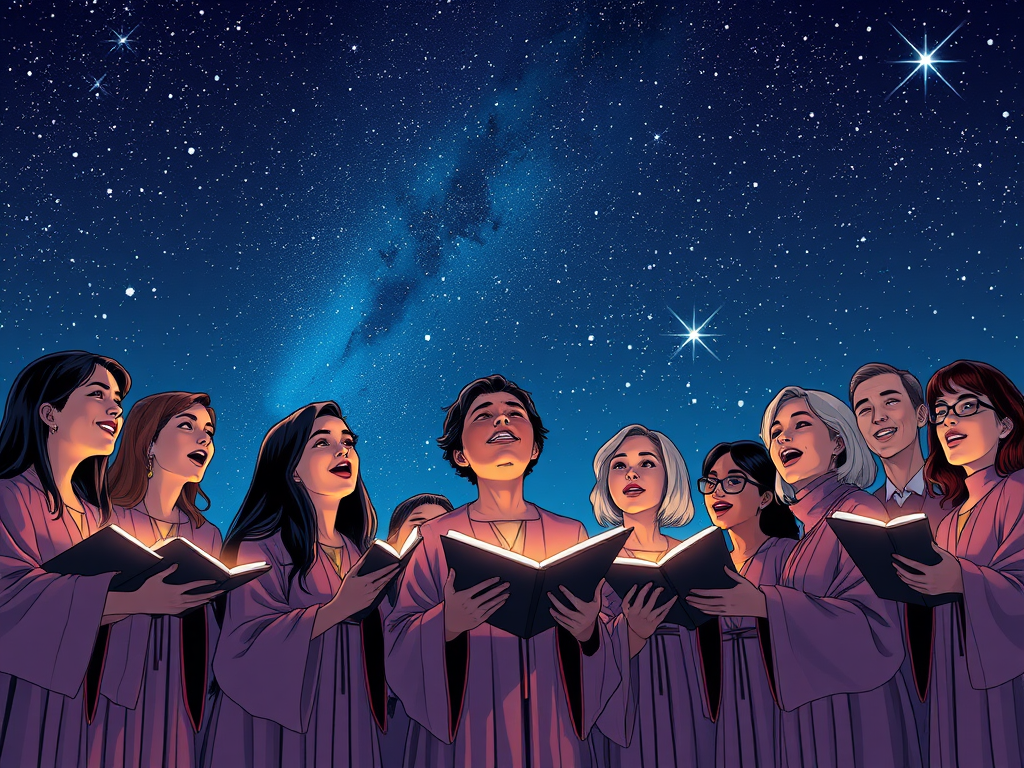
If reality is a song, we’re not passive listeners; we are active choir members. Every pulse we add—heartbeat, thought, invention—feeds back into larger bowls. Problems that look immovable at one layer (climate, inequality, existential risk) may soften when attacked through a neighboring transparency: tweak the ripple layer (financial incentives), or re-tune the nest layer (governance rhythms), and the whole chord can shift.
Hope, then, is not wishful thinking; it’s the physical possibility of retuning. The song is still being written, and we hold a few of the instruments.
Everything is a song.
References.
Abbott, B. P., et al. 2016. “Observation of Gravitational Waves from a Binary Black-Hole Merger.” Physical Review Letters 116 (6): 061102.
Casimir, Hendrik B. G. 1948. “On the Attraction Between Two Perfectly Conducting Plates.” Proceedings of the Royal Netherlands Academy of Arts and Sciences 51: 793-795.
Dobson, Ian, and Hsiao-Dong Chiang. 1989. “Towards a Theory of Voltage Collapse in Electric Power Systems.” Systems & Control Letters 13 (3): 253-262.
Ermentrout, G. Bard, and Nancy Kopell. 1986. “Parabolic Bursting in an Excitable System Coupled with a Slow Oscillation.” SIAM Journal on Applied Mathematics 46 (2): 233-253.
Hathaway, David H. 2015. “The Solar Cycle.” Living Reviews in Solar Physics 12 (4): 1-96.
Jacobson, Ted. 1995. “Thermodynamics of Spacetime: The Einstein Equation of State.” Physical Review Letters 75 (7): 1260-1263.
Kolb, Edward W., and Michael S. Turner. 1990. The Early Universe. Redwood City, CA: Addison-Wesley.
Kuramoto, Yoshiki. 1975. “Self-Entrainment of a Population of Coupled Non-Linear Oscillators.” In International Symposium on Mathematical Problems in Theoretical Physics, edited by H. Araki, 420-422. Berlin: Springer.
Lamb, Willis E., Jr., and Robert C. Retherford. 1947. “Fine Structure of the Hydrogen Atom by a Microwave Method.” Physical Review 72 (3): 241-243.
Lounasmaa, Olli V., and Pertti J. Hakonen. 2002. “Progress in Low Temperature Physics: Achieving Microkelvin Temperatures.” Proceedings of the National Academy of Sciences 99 (12): 6127-6132.
Milonni, Peter W. 1994. The Quantum Vacuum: An Introduction to Quantum Electrodynamics. San Diego: Academic Press.
National Oceanic and Atmospheric Administration (NOAA). 2025. “Oceanic Niño Index, 1950-Present.” Climate Prediction Center. Accessed 22 May 2025.
Nickolaenko, Alexander P., and Masashi Hayakawa. 2014. Schumann Resonance for Tyros: A Tutorial Lecture. Tokyo: Springer.
Planck Collaboration. 2020. “Planck 2018 Results. I. Overview and the Cosmological Legacy of Planck.” Astronomy & Astrophysics 641: A1.
Sakharov, Andrei D. 1968. “Vacuum Quantum Fluctuations in Curved Space and the Theory of Gravitation.” Soviet Physics–Doklady 12 (11): 1040-1041.
Schwinger, Julian, Lester L. DeRaad Jr., and Kimball A. Milton. 1978. “Casimir Effect in Dielectrics.” Annals of Physics115 (1): 1-23.
Verlinde, Erik. 2011. “On the Origin of Gravity and the Laws of Newton.” Journal of High Energy Physics 2011 (04): 029.
Citation per layers.
| Layer | Anchor citation(s) |
|---|---|
| Silk blanket / zero-point field | Casimir 1948; Schwinger et al. 1978; Milonni 1994 |
| Arousal (Planck-epoch heat) | Kolb & Turner 1990 |
| Heat (CMB today) | Planck Collaboration 2020 |
| Rhythm (pre-light phase lock) | Kuramoto 1975; Jacobson 1995 for thermodynamic framing |
| Heartbeat (closed feedback loop) | Hathaway 2015 (11-year solar cycle) |
| Ripples & spirals | Abbott et al. 2016 (GW150914) |
| Chaos / nonlinear phase escape | Ermentrout & Kopell 1986; Dobson & Chiang 1989; NOAA ONI 1997-98 dataset |
| Nested systems | Nickolaenko & Hayakawa 2014 (Schumann–circadian nesting) |
Comments