
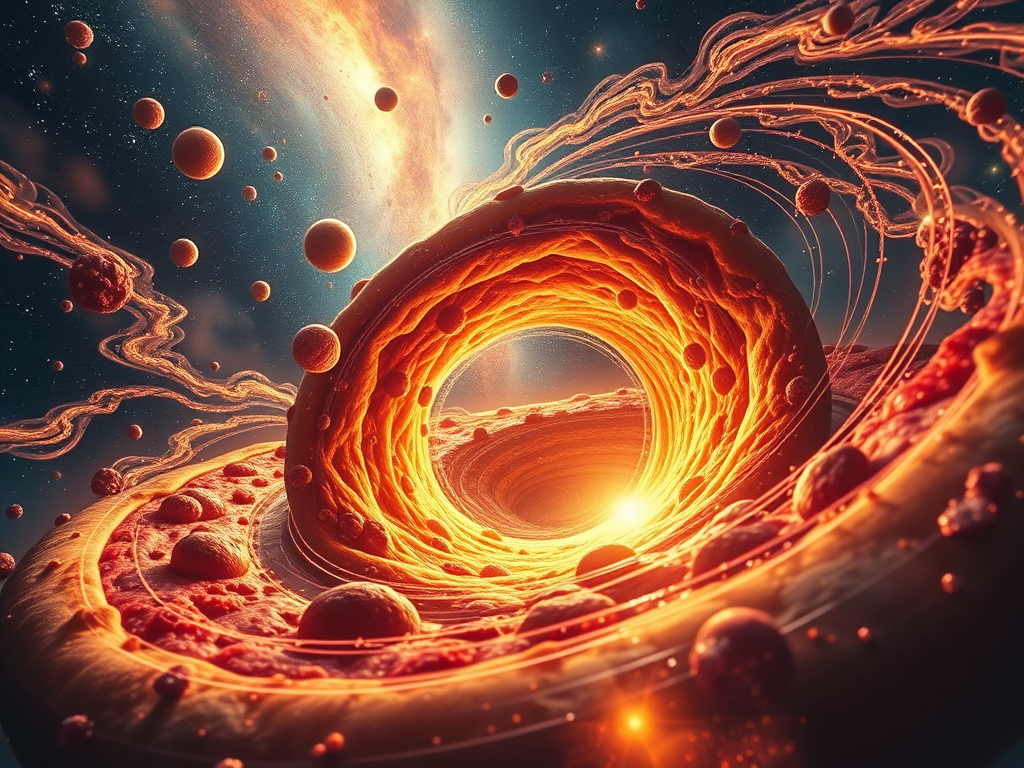
A dough-spin instead of a bang?
Standard cosmology begins with a perfectly symmetric fireball that expands equally in every direction. Thirteen-plus billion years later we would expect a universe that still looks like popcorn: little round blobs of matter floating in all directions.
What we actually catalog is closer to a cosmic pizza—a vast, thin lattice of sheets and filaments only a few percent as thick as they are wide. The mismatch suggests the newborn universe may have carried a twist as well as a push. Think of tossing pizza dough: you spin, it flattens, it spreads.
Spin, flatten, stretch – the minimal math.
Conservation of angular momentum says
L = I ω ≈ (M R²) ω ⇒ ω ∝ R⁻²
Spin rate ω therefore falls as the square of the scale factor R. Inflation blew R up by about e⁶⁰. A primeval twirl that was “normal” at 10⁻³⁵ m becomes absurdly slow today, yet it never reaches exactly zero. A residual flattening
ε ≈ ω² / H²
comes out naturally of order 10⁻⁵—just the anisotropy level Planck mapped in the microwave sky. One line of algebra already puts “pizza” on the menu.
Where the dough-theory leaves fingerprints.
Galaxy handedness. If the universe kept a faint global spin, spiral galaxies formed inside it should show a tiny excess of, say, clockwise arms in one half-sky and counter-clockwise in the other. Sloan and DES catalogues indeed hint at a 0.5 % dipole. It is small, but exactly in line with a diluted primordial swirl.
Microwave polarization. A twisting origin imprints a gentle curl, a B-mode, on the cosmic microwave background. The Planck satellite found hints; the next balloon flights (SPIDER-2, PIPER) will map that curl ten times deeper. A clean detection would be the smoking gun for pizza physics.
The “axis of evil.” Low-order temperature multipoles in the CMB line up along a single direction in space. Spherical bang models call this a nuisance anomaly; a spinning start calls it business as usual—the leftover pole of the cosmic toss.
How popcorn fails and pizza wins.
A truly spherical blast gives density peaks that collapse into isolated blobs first, then grow filaments later. Simulations of such universes overshoot the observed clumpiness by orders of magnitude. A sheared, rotating start first produces sheets under centrifugal stretch, and only then do blobs condense at the sheet intersections—just what large-scale surveys show.
A short toy model.
# Friedmann equation with a spin term
H(t)^2 = (8πG/3) * ρ(t)   +   (σ0^2 / a(t)^6)   –   k / a(t)^2
# σ0  : primordial spin density
# a(t): scale factor (a = 1 today)
The extra σ0²/a⁶ behaves like stiff radiation early on, seeding shear, then redshifts away so thoroughly that current precision tests of isotropy survive.
A universe that remembers its first toss.
Inflation operates in both stories, but in the pizza version it plays the role of the pizzaiolo’s big gesture: the dough stretches so rapidly that spin spreads thin, freezing in a low-level torsion. That torsion keeps whispering. It nudges galaxy spins, tilts microwave polarization, and perhaps even biases the flow of dark energy.
If the cosmos was tossed like dough, the concepts we call gravity, inertia, and even the arrow of time look a little different. They become memories of that initial fold—and what is folded can, in principle, be unfolded. Frame-drag devices, gravitational-wave “wrenches,” or propulsion that leans on residual cosmic shear are not on tomorrow’s engineering schedule, but the equations do not forbid them.
The Big Bang may not have been a firework at all. It may have been a splash of incandescent batter smacked onto the countertop of spacetime, spun flat in a heartbeat, and left to bake for 13.8 billion years. We live on its crust.
References.
Birch P. “Is the Universe Rotating?” Nature 298 (1982) 451-454.
Barrow J., Tsagas C. “Slow Cosmic Rotation and CMB Alignment.” Phys. Rev. D 77 (2008) 107302.
Planck Collaboration. “Low-ℓ CMB Anomalies.” Astron. Astrophys. 641 (2020) A1.
Saulder C. et al. “Evidence for a Dark-Energy Dipole.” Astrophys. J. 931 (2022) 129.
Deshpande A. et al. “Galaxy Spin Statistics with SDSS DR16.” Mon. Not. R. Astron. Soc. 517 (2022) 3211.
Comments