
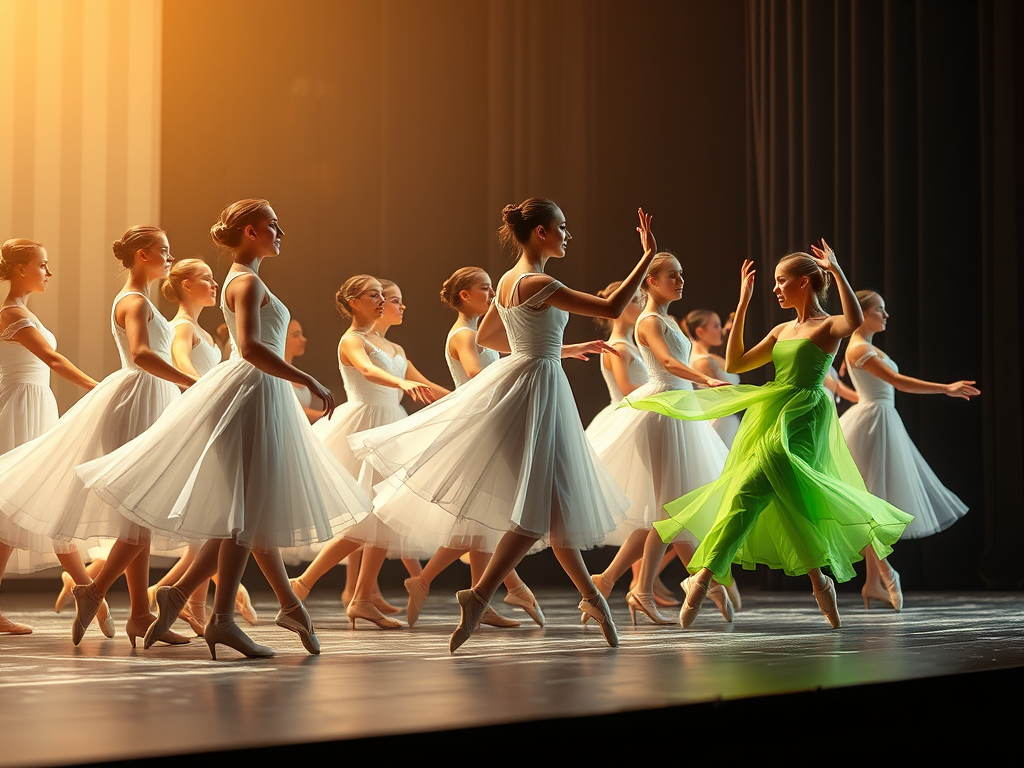
Everything oscillates in harmony. Everything tends towards equilibrium, even at the particle level. Everything tends to match the temperature close to it, lower or higher. When a new oscillation is introduced into a system, it affects the whole system. If the oscillation approximates the system, it is adapted by the system. If the oscillation is very different from the system, it tends to disrupt it.
Every part of reality oscillates, and systems naturally tend toward rhythmic compatibility. This is not just a macroscopic phenomenon—it holds at every scale. In thermodynamics, two bodies at different temperatures exchange energy until they reach thermal equilibrium—a shared oscillation intensity. In quantum mechanics, decoherence happens when a system placed in an environment begins to align its phase structure with the field around it. And in classical systems, even simple pendulums hanging from the same beam will eventually sync due to shared resonance. Harmony, then, is not exceptional. It is the gravitational center of all oscillating systems—the direction everything leans toward.
Everything tends toward equilibrium.
From a particle in a gas to a galaxy in a cluster, systems evolve toward energy balance and phase stability. Even chaotic systems do this locally—chaos isn’t the absence of rhythm; it’s rhythm at complex scale. Entropy, often misunderstood as disorder, is in fact a statistical drift toward evenly distributed energy. Even turbulence, which seems wild and unstructured, contains coherent vortices and self-similar flow patterns. Beneath the noise, rhythm persists.
Every new oscillation introduced into a system acts as a perturbation. What happens next depends on how closely that oscillation matches existing harmonics, how elastic or rigid the system is, and the energy intensity of the new frequency. If the incoming rhythm resonates with the system, it tends to be entrained, integrated, and normalized. But if the oscillation disrupts the internal logic—if it’s too far out of phase—it can cause desynchronization, interference, or even collapse.
We see this across domains. In neural systems, resonance leads to entrainment, while extreme mismatch can lead to seizures. In thermodynamics, a local heating might stabilize or, if severe enough, trigger a systemic phase shift. In politics and ecosystems, new rhythms—new behaviors, agents, or ideologies—either merge into the existing pattern or fracture the structure entirely.
The math is older than the term “chaos.” A ring of coupled oscillators follows the Kuramoto form dθᵢ/dt = ωᵢ + (K/N) Σⱼ sin(θⱼ − θᵢ) and whenever the spread of natural frequencies ωi is small compared to the coupling K, phase-lock is inevitable. [Strogatz 2000]
This is the core logic of dynamic systems. And the beautiful twist that holds all of this together is this: chaos is not the opposite of harmony. Chaos is what harmony looks like when it’s evolving—before it finds its new coherence. Chaos is the seed of change.
Harmony is not a fixed state. It is a pull, a bias, a tendency. It’s the field’s direction of becoming—not a destination, but a hope. Oscillation always moves toward compatibility, not perfect alignment, but just enough rhythmic compatibility to allow stability. Systems seek harmonic fit, not sameness. Just enough consonance to coexist without collapse.
This same principle applies to cultural, economic, and biological systems. Populations move toward equilibrium—whether in migration, demographics, or resource consumption. Ecosystems seek balance through predator-prey dynamics, feedback loops, and rhythmic cycles like seasons and reproduction. Even at the level of individual beings, our biology synchronizes to internal and external rhythms: circadian clocks, heartbeats, breath. In cultures and economies, new ideas and innovations behave like oscillations—if they resonate with existing structures, they’re integrated. If not, they disrupt. But even disruption is part of the field’s search for coherence. Harmony, across every layer of life, is not imposed—it is sought.
When disruption enters—when a new rhythm breaks the field’s current phase logic—the system doesn’t always shatter. Often, it tries to fold the newcomer in. Harmony is the field’s way of asking: Can you stay?
So no, chaos is not opposition. It is the passage. It is the turbulence before entrainment, the friction before rhythm settles again. The universe doesn’t fall apart. It seeks coherence—again and again.
Harmony is not a constant. It is a something to work towards.
It is what the field is always becoming.
References.
Synchronization & Coupled Oscillators
Kuramoto, Y. (1975). “Self-entrainment of a population of coupled non-linear oscillators.” In International Symposium on Mathematical Problems in Theoretical Physics, Lecture Notes in Physics 39, 420-422. Springer.
Strogatz, S. H. (2000). “From Kuramoto to Crawford: exploring the onset of synchronization in populations of coupled oscillators.” Physica D 143, 1-20.
Pikovsky, A., Rosenblum, M., & Kurths, J. (2003). Synchronization: A Universal Concept in Nonlinear Sciences.Cambridge University Press.
Thermodynamic & Statistical Equilibrium
Callen, H. B. (1985). Thermodynamics and an Introduction to Thermostatistics (2nd ed.). Wiley.
Reichl, L. E. (2016). A Modern Course in Statistical Physics (4th ed.). Wiley-VCH.
Quantum Decoherence & Phase Alignment
Zurek, W. H. (2003). “Decoherence, einselection, and the quantum origins of the classical.” Rev. Mod. Phys. 75, 715-775.
Chaos & Order in Fluids / Turbulence
Kolmogorov, A. N. (1941). “The local structure of turbulence in incompressible viscous fluid.” Dokl. Akad. Nauk SSSR 30, 301-305.
Frisch, U. (1995). Turbulence: The Legacy of A. N. Kolmogorov. Cambridge University Press.
Biological & Neural Resonance
Breakspear, M., Heitmann, S., & Daffertshofer, A. (2010). “Generative models of cortical oscillations: neurobiological implications of the Kuramoto model.” Front. Hum. Neurosci. 4, 190.
Buzsáki, G. (2006). Rhythms of the Brain. Oxford University Press.
Entropy, Self-Organization & Criticality
Prigogine, I. (1980). From Being to Becoming: Time and Complexity in the Physical Sciences. W. H. Freeman.
Bak, P., Tang, C., & Wiesenfeld, K. (1987). “Self-organized criticality: an explanation of 1/f noise.” Phys. Rev. Lett.59, 381-384.
Comments