
The Thing About Tariffs.
Tariffs are taxes imposed on goods entering a country. Historically, they’ve been used to protect domestic industries, raise government revenue, and—more recently—serve as strategic tools in global economic conflict. The idea is simple: make imported goods more expensive, and you create a price advantage for domestic producers. In theory, tariffs help a country regain control over production and reduce dependency on foreign supply chains. In practice, especially in an era of hyper-globalized manufacturing, they often backfire or create complex second-order effects that hit consumers and businesses more than geopolitical rivals.
One of the clearest examples of this contradiction is embedded in a small, technical policy change from the Obama era: the de minimis threshold increase. In 2016, just before leaving office, President Obama signed into law an update to the de minimis rule, raising the threshold from $200 to $800 per shipment. The goal was to make it easier for individuals to import small quantities of goods without getting caught in customs bureaucracy. At the time, it was seen as a way to simplify cross-border trade for consumers and businesses.
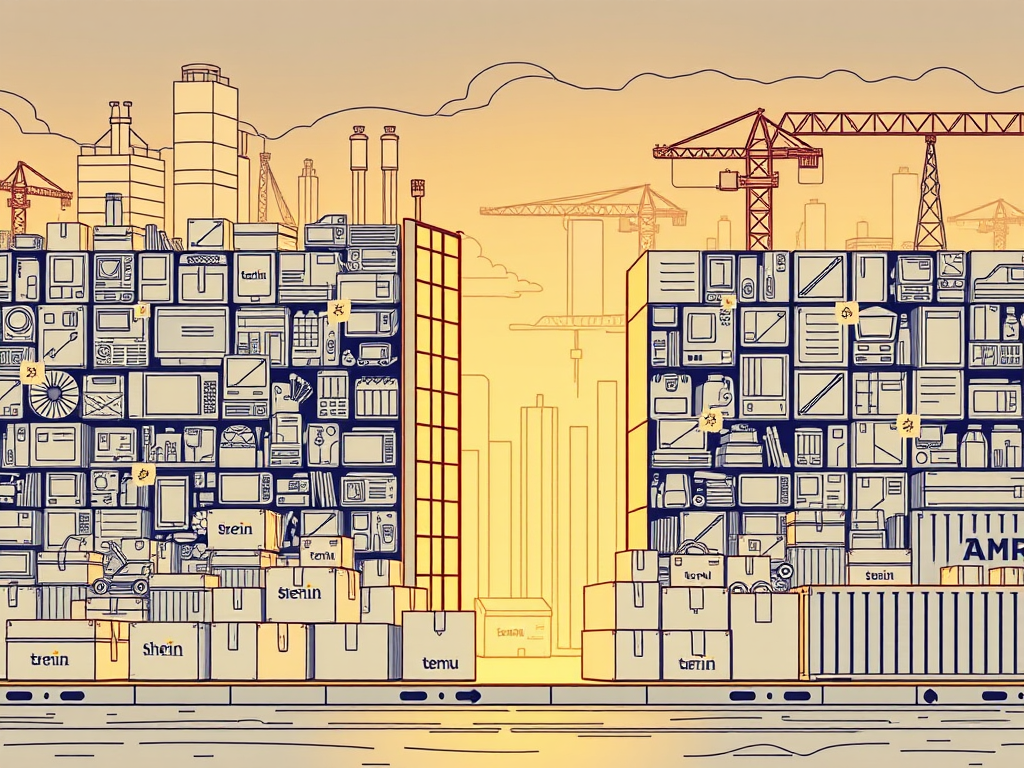
But what seemed like an administrative modernization soon became a strategic vulnerability. Companies like Shein and Temu, both Chinese e-commerce giants, built entire business models around exploiting this loophole. By shipping massive volumes of small, direct-to-consumer packages—each under the $800 de minimis threshold—they bypassed tariffs that U.S. businesses were paying on bulk imports. In effect, these companies slipped through the tariff wall, reaching American customers with ultra-cheap goods while avoiding the duties meant to counterbalance China’s trade dominance.
What started as a minor customs adjustment turned into a gaping hole in trade enforcement. While politicians on both sides of the aisle talked about “bringing manufacturing home” and “standing up to China,” de minimis quietly enabled the exact opposite. It allowed Chinese manufacturers to scale micro-distribution to millions of U.S. households, undermining domestic retailers and sidestepping the core intent of U.S. trade policy. The result is a contradictory system: tariffs for the press conference, loopholes for the supply chain.
Tariffs Through the Layers of Time and Space.
| Era | Concept | Narrative | Pattern | Contradiction | Energy Layer |
|---|---|---|---|---|---|
| Ancient to Early Modern | Power as border | “You’re in my land. Pay the toll.” | Local tolls, static friction | Wealth locked in place. No scale, no motion. | Tariffs = frictional nodesfor sovereignty assertion. |
| Mercantilism | Power as accumulation | “Keep gold in, push goods out.” | Empire hoards, colonies starve | Growth feeds core, rots periphery. | Tariffs = valves, forcing inflow, blocking outflow. |
| Industrialization | Power as self-fertilization | “Protect the child until it can fight.” | Infant industries bloom behind walls | Some never mature. Protection becomes a cage. | Tariffs = wombs. Friction buys time for self-formation. |
| 1930s Depression | Power as panic reaction | “Everyone else is the threat.” | Tariff spiral → collapse | Self-preservation kills global structure. | Energy collapses inward. No exit vector. |
| Post-WWII (GATT/WTO) | Power as shared stability | “Trade prevents war.” | Global flow managed by hegemon | Trust built on singular dominance | Tariffs removed → harmonic field logicreplaces borders. |
| Globalization Era | Power as optimized flow | “Let the market lead.” | Supply chain stretch, efficiency obsession | Fragile networks. No local resilience. | Tariffs mostly gone. Flow becomes hypersensitive. |
| 2018–2025 (Trump Era) | Power as reterritorialization | “Bring industry home.” | Tariffs spike. Retaliation. No decoupling. | Systems too entangled to isolate cleanly. | Tariffs = symbolic resistance in a cross-linked energy field. |
Where Trump Is Right—and Where He Is Wrong.
Donald Trump’s tariff strategy came from a place of clarity and frustration. He saw what many elite policy thinkers ignored for years: that America’s supply chains were no longer American, that its economic sovereignty had been hollowed out by efficiency-obsessed globalization, and that China had used access to U.S. markets to supercharge its strategic leverage. In that sense, Trump had his heart in the right place. He understood the stakes. He saw the fragility beneath the market smoothness. He was right to call out the imbalance.
But tariffs—at the scale and simplicity he wielded them—were the wrong tool for a distributed, recursive global economy. Tariffs are a blunt-force instrument designed for clear flows and clear enemies. Today’s flows are obfuscated, layered, and looped through shadow systems, bonded logistics, and overlapping jurisdictions. Blocking inputs doesn’t break the system anymore—it fractures the edge nodes while the core continues to mutate. Tariffs don’t rewire interdependence; they just make friction more expensive.
This isn’t a trade war. It’s a test of who can lose leverage the slowest—and still walk away with the map.
In August 2017, the United States Trade Representative launched a formal investigation under Section 301 of the Trade Act of 1974, targeting China’s trade practices. This move, authorized by President Trump, wasn’t just about steel or solar panels. It was about something far more foundational: intellectual property, technology transfer, and the quiet erosion of America’s strategic edge.
The 301 investigation concluded in early 2018 with a sweeping and damning report. It outlined how the Chinese government had pursued a systemic strategy of forced technology transfer, cyber-enabled IP theft, and discriminatory licensing policies—all aimed at accelerating its domestic tech ecosystem while weakening foreign competition. It identified industries critical to the future: semiconductors, artificial intelligence, robotics, aerospace, and next-generation information systems. The report didn’t just justify tariffs—it framed them as retaliation for an existential theft. In that framing, tariffs weren’t economic—they were defensive architecture.
What followed was a cascade of tariffs, counter-tariffs, supply chain scrambling, and public grandstanding. But what often gets missed in the mainstream narrative is that the conflict didn’t disappear when Trump left office—it intensified under Biden, just without the volume. Quietly, tactically, and with far less noise, the Biden administration tightened the screws.
In May 2024, Biden’s White House announced a sharp escalation: tariffs doubled on Chinese solar cells, and tripled on lithium-ion EV batteries. Steel, aluminum, and even certain categories of medical equipment faced new restrictions. Then in September 2024, the administration finalized a far more aggressive structure: 100% tariffs on Chinese electric vehicles, 50% on solar cells, and 25% across a suite of critical minerals and battery components. These weren’t symbolic moves. These were targeted strikes at the materials layer of China’s technological ascent.
The real war here isn’t over car prices or cheap imports. It’s about who owns the blueprints, who controls the training data, and who defines the infrastructure of the future. Section 301 was the first formal U.S. acknowledgment that China wasn’t just competing—it was climbing inside the core of Western innovation systems. What followed—across two administrations—was not a trade war. It was an IP war. A tech war. A cognition war. And it’s still escalating. Quietly. Systemically. Relentlessly.
The global economy is balanced on a contradiction: the country no one trusts is holding everything together.
The truth is, the world isn’t just dependent on China—it’s entangled with it. Not through a clean chain of supply and demand, but through a messy, asymmetrical nervous system of mutual vulnerabilities, partial control, and conflicting interests. Every layer—physical, financial, cognitive, and geopolitical—is threaded through Chinese infrastructure. Pull too hard, and the entire system convulses.
Manufacturing is the most obvious and most entrenched layer. Apple, Dell, Tesla, GM, and nearly every modern industrial company rely on Chinese factories—not just for low-cost labor, but for co-located ecosystems of tooling, assembly, logistics, and supplier redundancy. Moving that isn’t just expensive—it’s structurally slow. Partial shifts to Vietnam, India, or Mexico help, but they come with delays, quality risks, and broken linkages. Full replication of China’s manufacturing density would take over a decade and trillions in capital. Automation sounds promising, but it’s not yet scalable or cost-effective across the entire mid-skill industrial range.
Then there are materials. China refines the vast majority of the world’s rare earth elements, controls large portions of lithium and graphite processing, and owns extraction rights in Africa for cobalt and other metals. Countries like Australia, the U.S., and Canada may have the raw ore—but most of it still gets sent to China for processing. Rebuilding the refining layer is dirty, politically unpopular, and decades behind. The EU is reopening processing hubs. Africa is being pulled in every direction. But for now, China remains the unreplaceable node.
Even in semiconductors—a field where the West supposedly dominates—dependency cuts both ways. While China still relies on Western designs and lithography, the West still relies on China for chip assembly, packaging, and crucial materials like rare gases. About 60% of global packaging happens in China. Even if a chip is designed in California and etched in Taiwan, chances are it finishes life in a Chinese facility. Add Taiwan’s geographic vulnerability, and the risk landscape becomes obvious.
The green energy supply chain is no better. China produces over 80% of the world’s solar panels and dominates the battery component market—especially for LFP and NMC chemistries. EV companies depend on these inputs whether they acknowledge it or not. Retooling production in the West means higher costs, environmental battles, and long timelines. Tesla and BYD are both racing to localize, but only one of them is Chinese—and already scaled.
Finance is another thread. China holds less U.S. debt than it used to, but financial interconnectivity persists. Chinese middle-class capital flows into Western real estate and equity. Western hedge funds and commodity markets ride on Chinese performance signals. A collapse in China’s shadow banking or real estate sector would trigger asset liquidation, FX volatility, and EM contagion. Even as capital trickles out of China, the U.S. and China are walking a monetary tightrope—pretending they aren’t balancing each other while both know they are.
Maritime trade routes and port infrastructure are locked into geography. China’s eastern ports—Shanghai, Ningbo, Shenzhen—anchor global container traffic. Manufacturing hubs are built around these flows. Re-routing 30% of global trade isn’t just hard. It breaks the flowchart of modern logistics. Quiet efforts to reorient toward Vietnam, Mexico, the Suez Canal, or Morocco are underway—but these transitions take years, not quarters.
Even the intellectual ecosystem is fused. China sends hundreds of thousands of students to U.S. and EU institutions. AI research, biotech, and physics labs remain interdependent, funded across borders and built on mutual translation. Visa restrictions, export controls, and ideological firewalls are emerging—but full academic decoupling would slow discovery on both sides. And brainflow—unlike capital—doesn’t have easy on/off switches.
Then there’s the geopolitical layer. A stable China maintains calm in the Taiwan Strait. An unstable one triggers panic across Asia, Africa, and Latin America. China is the counterweight in many emerging regions, even when it’s resented. The CCP falling too fast creates power vacuums, refugee waves, and the possibility of civil conflict spilling outward. But if China rises too clearly, it normalizes authoritarian coordination as a competitive advantage. There is no clean decoupling here—only slow co-option, containment, or tightly managed erosion.
This isn’t dependence. It’s entanglement. China’s presence is not just one link in a supply chain—it’s embedded across domains. It’s in the ports, the chips, the academic networks, the commodities market, the infrastructure deals. It is, for now, the nervous system running through a body built for speed, not survival. And that’s why the West is walking sideways. Not declaring rupture. Not naming the war. Just quietly redirecting flow, building hidden backups, and hoping the bomb stays inert long enough to replace it with something better.
It’s not about tariffs. It’s about the trap we built, climbed into, and now have to redesign while we’re still inside it.
China controls roughly 80% of the world’s rare earth processing, and that figure alone should be treated as a red alert—not because rare earths are scarce in nature, but because no one else can turn them into something usable at scale. Rare earth elements (REEs) are a group of 17 metals that form the invisible backbone of modern civilization: from EV motors and missile guidance systems to smartphones, MRI machines, fiber optics, and quantum computing. They’re divided into light and heavy elements—some more abundant, others more valuable—but all critical. Neodymium and dysprosium power permanent magnets. Europium and terbium light up your screens. Gadolinium saves lives in medical scans. Erbium moves data through space and glass. Without REEs, everything modern—mobility, communication, computation, energy, defense—grinds to a halt.
Other countries have these elements—Australia, the U.S., Canada, Sweden, and especially African nations like the DRC and Madagascar—but China controls the processing. Not by geological luck, but by design. It built the mines, refineries, component plants, and export chains. It tolerated environmental destruction where others wouldn’t. It funded infrastructure-for-resource deals across Africa. It absorbed upstream and downstream logistics. It played the long game. Today, even when Western companies mine REEs elsewhere, they often still send the ore to China for separation and refinement—because the infrastructure to do otherwise doesn’t yet exist.
Refining rare earths is a toxic, energy-intensive, and politically sensitive process. The West backed away from it decades ago: California’s Mountain Pass shut down its refining operations in 2002 under the weight of environmental litigation. The EU has faced fierce opposition to every effort to restart its capacity. Africa lacks the regulatory and waste management infrastructure to do it safely. China stepped in where others stepped back—and built leverage no one can easily unseat.
We need rare earths not because we want them, but because our entire civilization has been architected around their properties. They enable clean energy and advanced warfare, mass communication and scientific discovery. They are the frictionless layer beneath progress, and the critical nodes of the new arms race. Rare earths aren’t optional. They are the mineral infrastructure of global power.
Everyone talks about decoupling. No one talks about what happens when the system pulls back and nothing’s left to plug in.
Tariffs are often framed as a way for the U.S. to push back against China—an economic strike in place of a military one. The logic is understandable: apply pressure on imports, disrupt China’s growth engine, and force strategic recalibration without risking open conflict. But in reality, tariffs are not dismantling dependency. They’re just raising the cost of pretending it doesn’t exist.
The problem isn’t ideological. It’s infrastructural. The U.S. economy and its leading companies are deeply entangled with China—not by accident, but by design. Supply chains were built for speed, scale, and cost-efficiency over the past three decades, and China became the gravity well around which everything else orbited. Now, trying to exit that system is like trying to walk away from your own nervous system. You can survive—but not without shock, loss, and time.
Why U.S. Companies Struggle to Leave China.
- China is the Factory of the World
Nearly 95% of iPhones are still assembled in China. Final assembly, precision tooling, rare earth-dependent component manufacturing—all of it remains entrenched in industrial zones that can’t be replicated quickly. Tariffs don’t move that. Patriotic slogans don’t unbuild thirty years of architecture. - China is Also the Growth Market
For many U.S. companies, China isn’t just where things are made—it’s where the money is. Tesla sells more cars in China than in the U.S. Apple, Nike, Starbucks, Qualcomm, GM—they all rely on Chinese consumption to hit quarterly targets. Leaving the Chinese market means forfeiting future growth and letting competitors fill the vacuum. - Decoupling Isn’t Binary—It’s Layered
The dependencies are not linear. They’re layered, fractured, and asymmetric. You can move some parts out. Others are cemented in place.
| System Layer | U.S. Control | China Control |
|---|---|---|
| Raw materials | No | Yes |
| Chip design | Yes (ARM, x86) | No |
| Chip manufacturing | Sorta no (TSMC reliant) | Not really (Catching up) |
| Final assembly | No | Yes |
| Software / IP | Yes | No (but narrowing) |
| Rare earths refining | No | Yes |
Conclusion: The U.S. holds intellectual leverage. China holds physical leverage. Neither can fully sever the tie without suffering strategic losses.
What Happens If They Try to Leave?
In the short term, stock prices drop. Consumer prices rise. Timelines balloon. Shadow markets emerge to fill the gaps.
In the medium term, companies like Apple diversify to India, Vietnam, or Mexico—but can’t scale at Chinese speeds. China retaliates. Brand loyalty collapses. Supply chains splinter.
In the long term, survival depends on something the U.S. hasn’t committed to in decades: rebuilding the physical layer—mining, smelting, shipping, manufacturing—and doing it under environmental, labor, and democratic scrutiny.
That’s not just expensive. It’s generational.
If the U.S. doesn’t rebuild true industrial sovereignty, the tariff war is not a strategy. It’s performance art. It raises costs without restructuring capacity. It signals strength while masking continued dependence.
Can U.S. companies leave China and survive?
- Big Tech? Maybe—but at the cost of profit margins and long-term dominance.
- Consumer brands? Only if they can replicate China’s logistics and market size in Southeast Asia, which isn’t plug-and-play.
- Manufacturing-heavy firms? Not without government backing, energy security, and a reimagined industrial policy.
If independence is the goal, then the real work starts after the tariff. That means:
- Supply chain sovereignty
- Strategic mineral and component stockpiles
- A reindustrialized workforce
- Regulatory alignment with allies
Anything less—and we’re just taxing the illusion of control.
We’re not living in a post-global world—we’re living in the hangover after global trust collapsed.
China holds immense power—but doesn’t know how to wield it without harming itself. It dominates rare earth refining, manufacturing, green tech, and infrastructure deals across the Global South. It controls more physical bottlenecks than any other country on Earth. But it can’t project that power with the sophistication or agility that the United States and its allies can. Power is not about possession. Power is about conversion. And China can’t convert what it owns.
Its attempts to leverage strength usually backfire. When it weaponizes rare earths, it spurs Western governments to fund alternative refining. When it leans too hard on port dominance or Belt and Road leverage, it triggers regional resentment. When it clamps down on dissent, it gains domestic compliance—but loses international trust, capital, and innovation. In trying to secure everything, China exposes its greatest weakness: its fear of chaos. It can build factories in weeks, but it can’t tolerate real-time disruption. It wants control without confusion. But confusion is where the West thrives.
The United States, by contrast, is structurally messy and strategically adaptive. It doesn’t have China’s control, but it doesn’t need it. It has the dollar. It has the alliances. It has the story. It has mutation. When China builds steel and refineries, the U.S. builds narrative infrastructure: institutions, standards, culture, protocols, trust. It doesn’t have to dominate supply chains to shift direction. It just has to make China second-guess its next move. In this game, the scalpel beats the hammer.
But even this is a comforting lie. The deeper reality is far more dangerous: China is a bomb. A fragile, overleveraged, tightly controlled system that the world depends on—not because it works, but because there’s no global backup plan. If China implodes, so do critical supply chains. So do energy markets. So do food exports, rare earth flows, component manufacturing, and debt markets. If it stabilizes, it becomes harder to contain, more credible as a global leader, and more dangerous to liberal democracies. If it fails, we bleed. If it succeeds, we fear.
So the real U.S. strategy—under both Trump and Biden—isn’t confrontation. It’s containment by delay. Stall China’s reach. Quietly rebuild supply alternatives. Rewire alliances. Hedge with India, with Africa, with Southeast Asia. Keep China functioning—but keep it isolated. Let it remain essential, but never trusted. The tariffs? The export controls? The semiconductor chokeholds? They’re not acts of war. They’re time-buying maneuvers. They’re about surviving the decade without having to choose between total collapse and Chinese hegemony.
Everyone is hoping the bomb doesn’t go off—but no one is sure what to do if it doesn’t.
There Has To Be a Better Way…
And the better way isn’t more confrontation, more tariffs, or more shadow wars. The better way is to make friends—and party. That doesn’t mean naïve diplomacy or wishful thinking. It means seeing global alliances not as moral positions, but as infrastructure investments in future survival. It means recognizing that China’s real vulnerability isn’t in its navy or its currency—it’s in its food chain.
China buys enormous volumes of rice and soy from Argentina. It is the top buyer of soybeans, soy oil, barley, and beef from across Latin America. But this isn’t just trade. It’s quiet dependency. It’s China hedging against its own agricultural limits—only 7% of the world’s arable land, much of it degraded, and a population that consumes faster than the soil can sustain. In a global system that’s becoming more fragile, food isn’t just a commodity. It’s leverage.
This is where the U.S. has the chance to do something extraordinary: stop fighting for dominance, and start building for resilience. Preemptively buy the food. Offer better deals—not through coercion, but through trust, through stability, through shared benefit. Outbid China not with cash, but with security, infrastructure, and long-term loyalty. Pay farmers with predictability. Pay nations with sovereignty. Pay friends with friendship.
Because the future won’t be decided by who builds the fastest chip, or who throws the heaviest tariff. It will be decided by who still gets grain when the ships stop moving. Who still gets clean power when the minerals are cut off. Who still has trust when the data goes dark.
That’s the world we’re building. Not a new Cold War. A warm alliance. A distributed resilience network. A party where the invitation itself is the power.
So go.
Mr. President. Elon.
Now do your thing.
Go break something dangerous—
by building a weakening structure around it, and letting it
fall.
Comments