
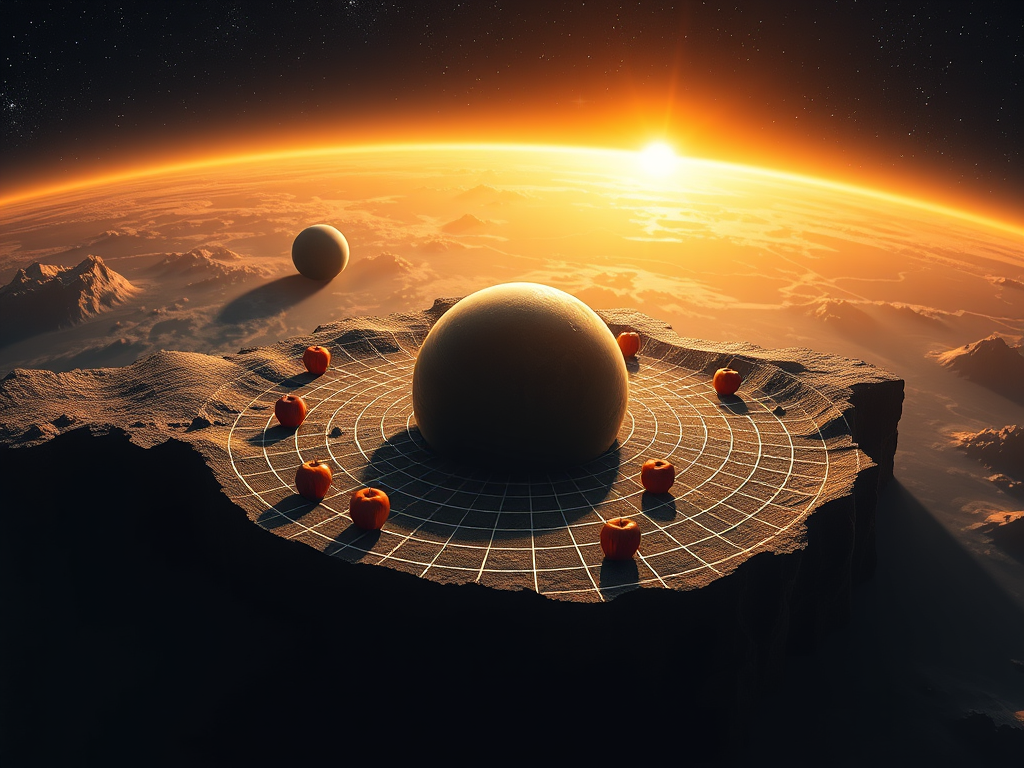
Gravity has shaped our understanding of the universe for centuries. From Newton’s invisible pull, to Einstein’s bending of space-time, to Wheeler-DeWitt’s removal of time itself, our understanding of gravity has changed dramatically.
What was once seen as a fundamental force might not even exist. Gravity has evolved from a universal force, to a curvature effect, to something that may only emerge when we observe it.
What if gravity is not a fundamental feature of reality—but simply a product of how we measure the universe?
Newton: Gravity as a Force (1687)
Newton’s Law of Universal Gravitation describes gravity as a force that pulls objects together.F=Gm1m2r2F=Gr2m1m2
Where:
- FF = Gravitational force between two masses
- GG = Universal gravitational constant
- m1,m2m1,m2 = Masses of two objects
- rr = Distance between them
Newton’s gravity acts instantly across empty space—every object exerts a force on every other object, regardless of distance.
Newton’s model worked perfectly for hundreds of years, but it had a problem: What is actually transmitting this force? How does gravity act across empty space with no medium to carry it? Newton himself admitted he had no idea—he could describe gravity, but he could not explain it.
Newton’s gravity is like an unseen tether between objects—but he never explained what “pulls” them together.
Einstein: Gravity as the Curvature of Space-Time (1915)
Einstein’s General Relativity replaced Newton’s force-based gravity with something radical:
– Gravity is not a force—it is the curvature of space-time.
– Mass tells space-time how to bend, and that bending tells objects how to move.
– Gravity does not act instantly—it moves at the speed of light.
Einstein’s Einstein Field Equations (EFE) describe this curvature mathematically:Gμν+Λgμν=8πGc4TμνGμν+Λgμν=c48πGTμν
Where:
- GμνGμν = Einstein tensor (curvature of space-time)
- ΛgμνΛgμν = Cosmological constant (expansion of space-time)
- TμνTμν = Energy-momentum tensor (mass-energy distribution)
- GG = Gravitational constant
- cc = Speed of light
This new model explained how planets orbit stars, why light bends around massive objects, and how black holes form. Instead of objects pulling on each other, Einstein’s gravity says that space itself bends around massive objects, and smaller objects move along those curves.
This solved Newton’s missing force problem—gravity doesn’t need a force, because it is space itself.
But Einstein still assumed space-time is real. What if space-time itself is just a construct?
Wheeler-DeWitt: Gravity Without Time (1967)
The Wheeler-DeWitt equation takes Einstein’s ideas even further and removes time entirely. The equation is:H^Ψ=0H^Ψ=0
Where:
- H^H^ = Hamiltonian operator (total energy of the universe)
- ΨΨ = Wave function of the universe
This means:
– Time does not exist at the most fundamental level of physics.
– The universe does not evolve in time—it simply exists.
– Gravity, as a space-time effect, may not be fundamental either.
If time is an illusion—a side effect of measurement—then gravity must also be an emergent effect, not a fundamental force.
If time and space are just constructs, then what is gravity actually bending?
The Big Question: Is Gravity Even Real?
Let’s look at the evolution of gravity across these three models:
| Theory | Key Elements | What’s Missing? |
|---|---|---|
| Newton (Force Model) | Mass, Distance, Force, Gravitational Constant | No explanation for what “transmits” gravity |
| Einstein (Space-Time Model) | Space-Time Curvature, Mass-Energy, Speed of Light, Cosmological Constant | Still assumes space-time is fundamental |
| Wheeler-DeWitt (Quantum Gravity Model) | Quantum Wave Function, Energy, No Time | Time and space do not exist at a fundamental level |
Newton says gravity pulls—but he doesn’t know how.
Einstein replaces force with geometry—but space-time still assumes time is real.
Wheeler-DeWitt removes time completely—suggesting gravity might just be a feature of how we measure reality.
If gravity depends on space-time, and space-time itself is just a construct, then gravity might not be real at all.
So What Actually Holds Everything Together?
If gravity isn’t a force, and space-time is just a measurement framework, then what is actually keeping the universe in order?
Could gravity be a shadow of observation—something that only exists because we measure it?
If time does not exist fundamentally, then does motion even exist—or is it a shadow caused by jumping between states?
Are we missing an even deeper framework that underlies all of physics?
The problem isn’t just explaining what gravity is—it’s realizing that we might not even be asking the right question.
If gravity is just an effect of how we observe the universe, not something “out there”. If Newton’s force, Einstein’s curvature, and Wheeler-DeWitt’s timeless state all describe gravity differently. If time is not real, and space is a construct.
What happens when we stop assuming gravity exists at all?
Comments