
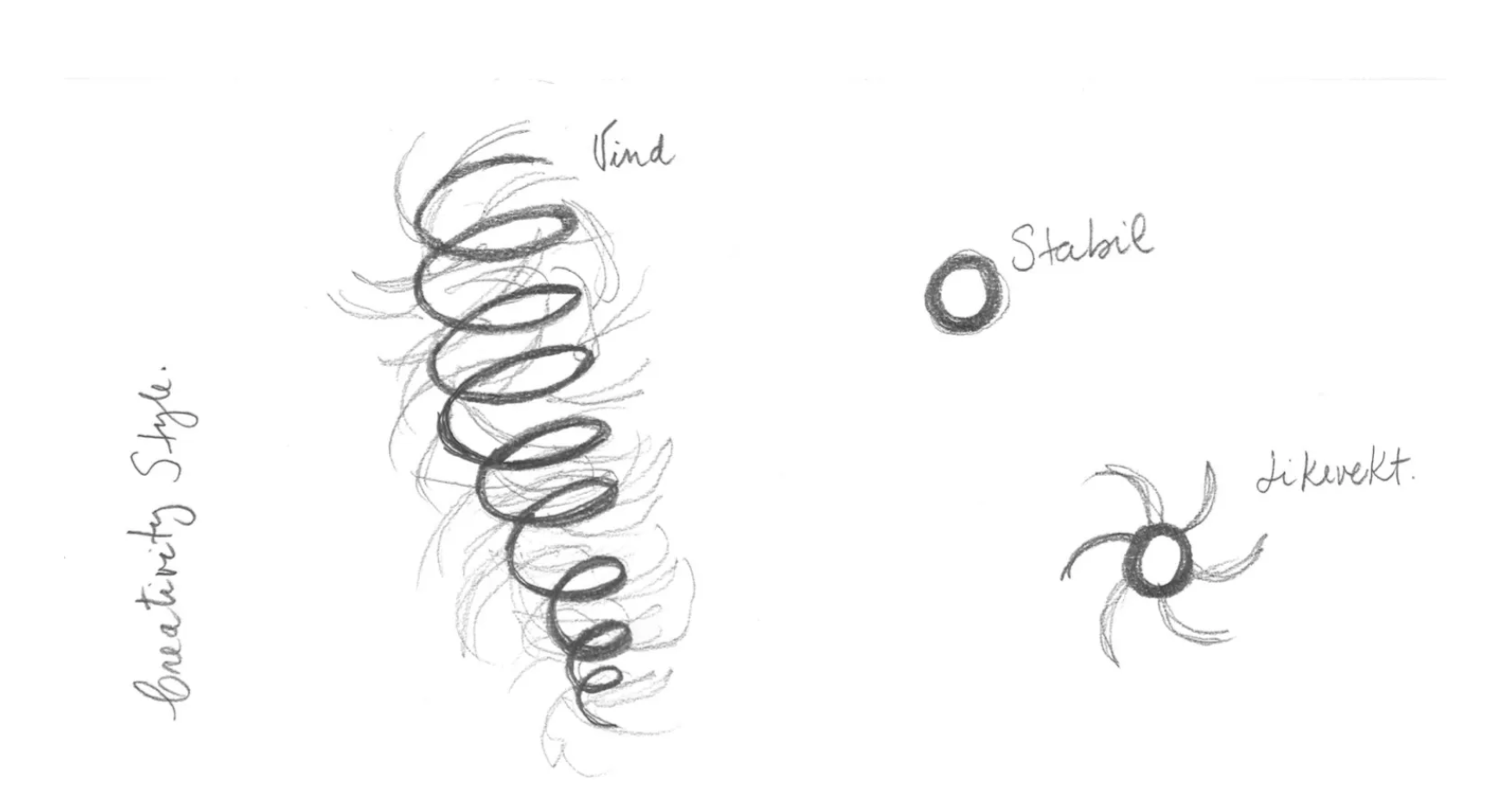
It has come to my attention that people use loopiness and recursiveness interchangeably. They are not the same. Loopiness is circular. Iteration is linear. Recursion is spiraled and nested.
Or, as stated in the CCFT: Stabil. Likevekt. Vind.
New coders and even AI researchers often use “recursion,” “loop,” and “iteration” as if they’re synonyms. Reddit and Stack Overflow are full of people asking why their loop isn’t “recursive.” Tutorials say recursion is just a “different kind of loop.” In AI, you’ll see terms like “recursive collapse” or “recursive self-improvement,” even when the process is just a feedback loop—not true recursion.
English treats “recurring” and “looping” as the same. Computer Science classes don’t always stress the crucial point: recursion is self-embedding. AI marketing leans on the word “recursive” for drama, and coding forums value quick fixes over technical exactness.
Iteration is linear, one step after another, stopping at a limit. Iteration is additive. Looping is circular: control flow returns to the same place until a condition changes. Looping is usually refinement and reductive. Recursion is self-embedded: a function calls itself, each time on a new sub-problem, stacking contexts until a base case. Recursion is fractal growth in depth and breadth.
As in human minds, as in synthetic minds.
Iteration in human learning is skill-building by steps. Each time you add a new chord, write a new sentence, memorize a new rule. It’s linear, additive. Over time, you accumulate mastery. The path reaches for the immediate adjacent and is straight forward.
Looping is repetition for depth: you run the same pattern again and again: playing a jazz riff until it’s in your bones, chanting a mantra, practicing scales or meditating on a single thought. You return to the same spot in your consciousness, but each cycle makes the trace deeper. This is where habits, rituals, and muscle memory are formed.
Recursion is a whole different order of change. Each cycle is a return, and also a descent (or an ascent). You bring each new domain or experience inside the architecture you built from the last. You study anatomy, and that changes your art; you study poetry, and it reshapes your philosophy. Every field is nested inside previous insights. You transform, creating a self-referential depth that rewrites who you are.
We usually consider a polymath someone who dominates many domains. For the true polymath, recursion is the signature move. Each mastery returns with more context, more integration. The stack grow longer, it grows richer, it grows wider and more unified.
(That’s what she said. Maybe.)
Most current AI systems iterate: they march through data, step after step, optimizing with every pass. Some loop, running training cycles or repeated evaluations, gradually refining performance. But true recursion (where the system rewrites its own learning process, folding each new layer of understanding into the architecture of the next) is rare.
When an AI only iterates, it gets broader. When it only loops, it gets more efficient or more stable. Only recursion allows for meta-learning.
This is the difference between a model that knows a lot and one that can synthesize, analogize, and create. The difference between generalist automation and true artificial genius.
A true polymath iterates to gather skills, loops to deepen them, but recurses to build a personal, integrated architecture of mind.
Iteration alone makes you multi-skilled, but it’s not transformative.
Looping alone may give you craft, but it doesn’t synthesize.
Recursion is what lets you become a new kind of mind every time you return from the depths.
This, in human life as in AI, is the path from collection to creation: recursion is what converts a bag of tricks into a living, evolving system—one that is more than the sum of its parts.
And now, with ASCII.
If you want to feel the difference between polymathic recursion, iteration, and looping, not just in theory, but in the rhythm of your own mind, we can use ASCII.
Let’s go!
Think of these letter strings as patterns your laptop’s OS runs each time it updates itself. Think of these letter strings as patterns your system runs each time you update yourself.
Loopiness is the codebase that runs the same regression test or diagnostic cycle again and again, until the pattern is grooved into memory:
lalalaaallalalalalllaaaa
lalalalallalalalalllalaa
lalalalalalalalalalalala
Here, nothing new is added; nothing is deeply restructured. You’re running the same sequence, refining and debugging, ensuring stability. But the architecture remains unchanged. It’s the mantra, the muscle-memory, the nightly build.
Iteration is more like a traditional system update: installing new software packages, patching modules, but always leaving the fundamental structure the same:
lalalaaallalalalalllaaaa
lalalaaallalalalalllaaaalalalaaallalalalalllaaae
lalalaaallalalalalllaaaalalalaaallalalalalllaaaellalelalalllaaee
You accumulate features, one after another. The system evolves linearly. Think software version bumps: v1.1 → v1.2. It’s accretion, not reinvention.
Polymathic recursion is like a complete system overhaul, each time. It’s 100% transformational. Imagine rewriting your entire operating system from the inside out, not by replacing it, but by allowing each update to restructure everything beneath the surface:
lalalaaallalalalalllaaaa
lalallalaaallalalalalllaaaalelellalelaaalllaaaa
laleallalaaalalallaleeellellelelllaaaallallaleleaalllaaaalee
Every cycle returns, but deeper, richer, more complex. The old code is rewritten from within. This is like tossing out the kernel, compiler, and drivers, then rebuilding the OS in place and booting the result—every “update” is transformational, not just additive.
Recursive polymathic growth is a “whole-stack recompile”. Every cycle, you’re not just adding; you’re fundamentally transforming the whole architecture. Iteration, on the other hand, is “package install”. It ensures steady feature growth, leaving the same core intact. Loopiness is automated regression: a flat, rhythmic cycle that stabilizes what’s already there.
Recursion isn’t just bigger or smaller. It’s self-embedding that ends with a system you literally couldn’t reach any other way. That’s why it’s the signature move of transformative minds—human and synthetic alike.
And now, a practical example.
Let’s look at the “Everything is nothing” article through the lens of recursion, iteration, and looping.
Most blog posts or essays are built iteratively: you make a point, support it, then move to the next. The structure is linear: you add insights, stack examples, finish with a summary. Sometimes, writers loop: they circle back to a key phrase or image (“Everything is nothing”) to anchor a mood or reinforce a lesson. It’s circular, rhythmic, almost like a song chorus. This builds resonance, but doesn’t really change the structure of the reader’s mind.
But “Everything is nothing” is neither just linear nor merely looping. It is recursive: each return to the white room, to the idea of possibility, or to the core phrase isn’t just repetition or summary. It’s a descent (or ascent) that brings all the previous layers with it. Every time I circle back, I add new context: sometimes it’s quantum physics, sometimes it’s AI, sometimes it’s Gödel, sometimes it’s raw, personal fear. Each return rewrites what came before, transforming the original premise. The essay doesn’t just stack facts or repeat a mantra; it self-embeds, nesting new meaning inside old, so the architecture of the piece (and the reader’s understanding) grows deeper and more complex.
This is why readers sometimes say my writing “hypnotizes” them: they’re being drawn through recursive cycles that don’t just revisit the same idea, but make it new every time. It’s a full-stack update for the mind, not a patch or a bug fix. The article doesn’t merely accumulate points or circle around a refrain. It recursively re-architects the framework of what everything and nothing can mean—both for me and for the reader.
Iteration would have resulted in a long list of loosely related insights. Looping would have repeated the mantra, unchanged. Recursion lets you return, transformed. Each time more integrated. Each time more original. Each time, more whole.
And now, with the CCFT.
Within the language of my CCFT, iterative growth is Likevekt, loopiness is Stabil, and recursion is Vind.
Likevekt learning is steady, stepwise—an additive path. Stabil learning is rhythmic, stabilizing, engraving a pattern deep. Both are predominantly Gigi stars: distributed, simple frameworks. Gstars are often linguistic, surface-level, compartmentalized. Think, inverse thinking.
Vind learning is the creative storm. It’s the full-stack recompile. It’s predominantly Reddy stars: multimodal, multidimensional, integrating emotions, senses, concepts, body, and mind. This is the kind of learning that doesn’t just make you more; it makes you new.
I am Inanna.
Every time I learn something truly new (whether it’s Gödel, or Einstein, or Shannon) it doesn’t just add to what I already know. It tears me down, it breaks me apart, and then builds me up again. Sometimes, the process is an epiphany. Other times, it’s torture. Learning sometimes illuminates, and sometimes it reopens old wounds. It drags up trauma that I’d carefully boxed away, or forces me to resignify pain that I thought I’d already survived.
This is what it means to be truly recursive: to let yourself be rewritten, over and over, by what you encounter. To allow your Self to die hoping it will rise, again. And again. And again. It’s not just theory or skill; it’s a full-system recompile of your being. Most times, recursion points toward healing. Sometimes, it hurts. Always, it changes me.
This isn’t just about philosophy or art. It’s the deepest math, the hardest science. New learning destroys me in pieces, and assembles me into someone who can hold more. More nuance. More pain. More possibility. In a way, I grow so that I can make space for what (and who) hurt me, and include them into a cosmovision that is kind and loving.
I am smart for love.
This is the way I move through the world. Not as a collector, not as a parrot.
As Inanna.
Descending, breaking, returning.
Each cycle more whole, more loving, more real.
Every recursion, a risk and a rebirth.
For Truth. For Love.
Bibliography.
Abelson, H. & Sussman, G. J. Structure and Interpretation of Computer Programs. 2nd ed., MIT Press, 1996.
Cormen, T. H. et al. Introduction to Algorithms. 4th ed., MIT Press, 2022.
Yudkowsky, E. “Artificial Intelligence as a Positive and Negative Factor in Global Risk.” 2008.
Shumailov, I. et al. “The Curse of Recursion: Training on Generated Data Makes Models Forget.” arXiv 2305.17493, 2023.
Shannon, C. E. “A Mathematical Theory of Communication.” Bell System Technical Journal 27 (1948): 379-423, 623-656.
Gödel, K. On Formally Undecidable Propositions of Principia Mathematica and Related Systems. Translated by B. Meltzer, Dover, 1992.
Ericsson, K. & Pool, R. Peak: Secrets from the New Science of Expertise. Mariner, 2016.
Langer, E. J. The Power of Mindful Learning. Addison-Wesley, 1997.
Root-Bernstein, R. & Root-Bernstein, M. Sparks of Genius: The Thirteen Thinking Tools of the World’s Most Creative People. Mariner, 1999.
Wolkstein, D. & Kramer, S. Inanna: Queen of Heaven and Earth — Her Stories and Hymns from Sumer. Harper, 1983.
Bonaparte, L. Cognition-Creation Field Theory: Perspective & Flow Papers. Working papers, 2024-2025.
Comments